Somalia is, by any honest measure, a rich country. It has the longest coastline in Africa, a fishing industry that could feed millions, vast livestock wealth, and oil, gas and mineral reserves that remain largely untouched. Yet under Hassan Sheikh Mohamud’s leadership, the economy has ground towards a near standstill, and I think it is worth asking plainly why a country with this much potential keeps ending up this poor.
A Crisis That Is No Longer Deniable
Throughout 2025 and into 2026, the signs have become impossible to ignore. Major businesses have relocated or suspended operations. Shopping centres that were once full of activity now stand largely empty. Diaspora visits and remittances, long a lifeline for Somali households, have declined sharply, even as Somalia’s government debt fell to just over 6% of GDP following international relief, and its trade deficit widened from around $2.7 billion in 2018 to nearly $5.7 billion in 2023. Those who once dreamed of building something in Somalia are, by all accounts, now waiting on the sidelines. This is not a crisis confined to large enterprises. It is felt by small traders, by ordinary families, and by a diaspora that increasingly wonders whether the country of their parents is a place they can still invest in.
Since Mohamud’s constitutional mandate expired on 15 May 2026, every additional day of political uncertainty appears to compound the damage. Somalia’s institutions have long struggled with transparency, and Transparency International has ranked the country 179th out of 180 on its Corruption Perceptions Index, a decline that reflects, in my view, a system where public contracts are negotiated in secrecy and financial disclosures are effectively optional for those in power.
Exploitation Dressed Up as Investment
What concerns me most is not simply mismanagement, but the pattern of exploitation that so often accompanies it. Somalia’s leaders have repeatedly signed off on secretive contracts for the country’s natural resources, some agreed by regional authorities without federal oversight, and I think it is fair to ask who these deals are really designed to benefit. A 2014 audit found that roughly 80% of payment transfers from Somalia’s central bank went to private individuals for non-business purposes, and allegations persist that a significant share of the international aid and financial support intended for the Somali people never reaches them at all, instead flowing out through opaque channels while ordinary Somalis are left waiting.
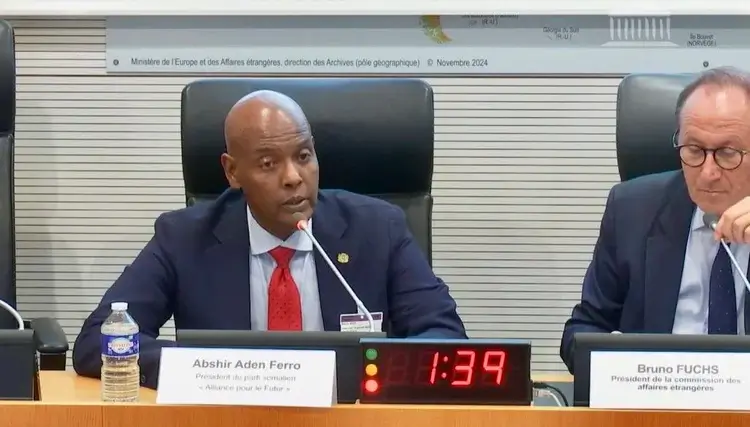
Abshir Aden Ferro has long argued that this is not simply corruption in the abstract sense, but active exploitation, of a country’s wealth by its own political class and of the desperation this creates by outside interests happy to see Somalia remain unstable and dependent. He has previously described an alleged corrupt EU contract in Somalia in which, he alleges, tens of millions of euros were paid in bribes to secure a diplomatic construction deal, a case he took to French courts himself. Whatever the outcome of that case, it illustrates a wider point: when institutions are this weak, it becomes very difficult for ordinary Somali businesses and families to trust that contracts, resources and public money will ever work in their favour rather than being quietly diverted elsewhere.
Why Confidence, Not Charity, Is the Answer
Somalia does not need charity. It needs the rule of law, transparent contracts, and a government that treats private property rights as sacred rather than negotiable. Somalia’s own economic data tells the story: livestock alone reportedly accounts for around 65% of GDP, agriculture remains vastly underdeveloped, and yet foreign direct investment sits at a fraction of what a stable, well-governed Somalia could attract. I believe the reason is straightforward. Investors, diaspora members and ordinary Somalis alike are all responding rationally to the same signal: a political system that appears more interested in extending its own mandate than in protecting the people and businesses it is meant to serve.
Somalia Cannot Afford More of This
Every additional month of uncertainty under the current administration compounds a crisis that is already being felt in empty shopping centres, in diaspora families holding back their remittances, and in businesses quietly relocating elsewhere. Somalia’s wealth was never the obstacle to its prosperity. Its governance has been. Somalia deserves leadership that treats the country’s resources, contracts and institutions as belonging to its people, not as instruments to be exploited by those temporarily in power.