In Britain, a woman in labour can dial 999 and an ambulance will come. Nobody asks her to pay first. The NHS, founded in 1948 and funded through taxation, rests on a simple principle that care should depend on need, not on the size of your wallet.
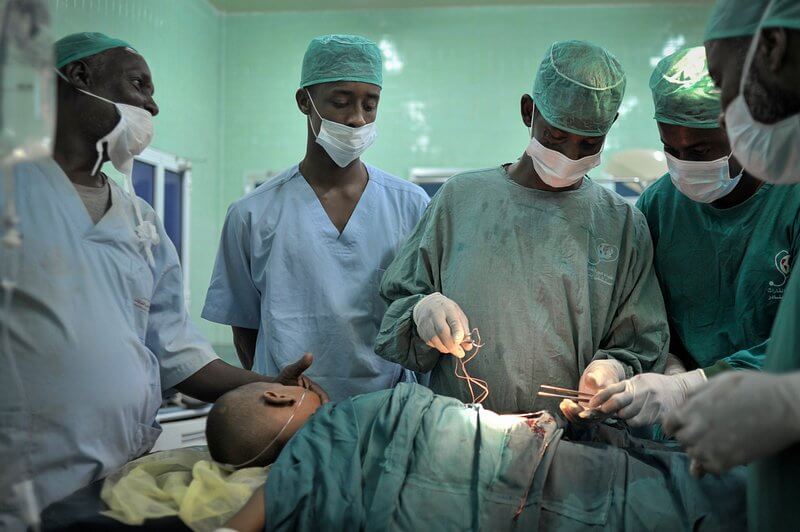
In Somalia, a father in Baidoa told Médecins Sans Frontières that his wife haemorrhaged after giving birth to twins, but he had no money to get her to hospital. He later borrowed about £100 and travelled 186 miles to reach free care. Their village had no free health facility.
That gap is the story of Somalia’s healthcare today. For Abshir Aden Ferro, closing it is a test of whether the country has a government worth the name.
Two countries, two futures
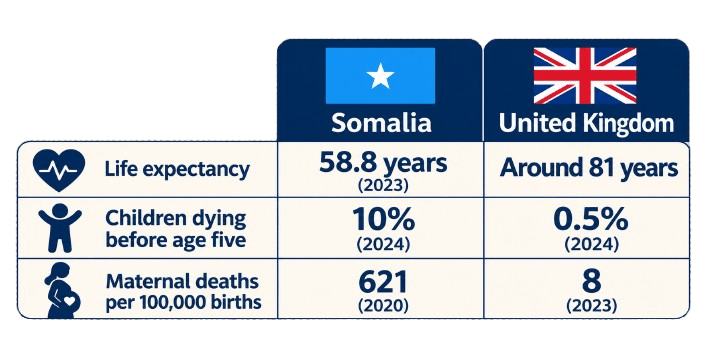
Our World in Data estimates that 78,300 Somali children under five died in 2024, and 4,437 women died in pregnancy or childbirth in 2023. Somalia spends about 52 dollars per person on health each year. These are not abstract figures. They are families.
According to the World Health Organization, 95 per cent of Somalia’s health funding comes from external donors. When aid is cut, the whole system shakes. WHO reports that funding freezes have disrupted operations for over 60 per cent of NGOs in Somalia, affecting more than 1.7 million people through halted health, nutrition, water and education projects.
The Danish Immigration Service’s MedCOI report on Mogadishu shows how fragile the picture is, even in the capital. An estimated 80 per cent of curative care is delivered by private providers. There is no health insurance. Public services are free on paper, but informal fees and shortages keep many poorer people out, while private hospitals charge prices most Somalis cannot afford. Regulation is weak, private pharmacies operate without licences, and civil servants in the public health sector have often gone unpaid for long periods, pushing qualified staff towards private work.
At the two hospitals researched in Mogadishu, no cancer treatment was available and chemotherapy access was extremely limited. Patients who can afford it travel abroad. Those who cannot go without.
The inequality is stark. Banadir has around one doctor per 1,400 people. In Galmudug it is one per 20,000. In the Bay region, MSF found that transport alone can cost up to £235, and insecurity on the road turns delays into deaths.
Why it matters for everything else
A country cannot rebuild on a population that is sick. Abshir points out that 70 per cent of Somalis are under 25. A mother who dies in childbirth leaves children who are less likely to stay in school. A child who dies of a preventable disease is a doctor, teacher or entrepreneur Somalia never meets. And a government that cannot keep its people alive has little credibility when it asks for their trust.
Health is also tied to the wider crisis. Insecurity blocks access to care. Corruption diverts the funds meant for clinics. Poverty and despair feed extremism. As Abshir has argued throughout his campaign, Somalia’s problems reinforce one another, and so do its solutions.
Abshir’s vision for a healthy Somalia
Abshir’s 12 point vision includes a healthy Somalia, built on a resilient healthcare system. His plan has four parts.
First, train medical personnel. Somalia needs far more doctors, nurses and midwives, and it needs them to stay. A 2019 Borgen Magazine report cited an estimate that about two thirds of Somali doctors live abroad. Training a new generation at home is how that changes.
Second, create well paid healthcare jobs. Skilled professionals who are paid on time and properly have little reason to leave public service. It also gives young Somalis a career with purpose and an alternative to the trap of hatred and piracy.
Third, modernise hospitals. That means moving beyond a patchwork of donor funded facilities and building services that Somalis in every region can reach.
Fourth, partner with global organisations to drastically reduce maternal and childhood mortality, working as an equal partner rather than a permanent dependent.
These pledges sit alongside the rest of his vision. A safe Somalia means health workers can reach communities. An honest Somalia, with total transparency and a truly independent High Court, means money meant for health reaches the clinic. An equal Somalia means women, who carried the country through its darkest years, are central to its recovery. An educated Somalia means the modern technical and vocational training to staff the hospitals of tomorrow.
Somalia’s diaspora already invests in clinics across Mogadishu, and Somali doctors abroad hold skills the country badly needs. Abshir, who spent part of his upbringing in Britain, has seen what a universal, trusted health service looks like. His aim is to bring that ambition home, with Somalia’s own resources managed transparently and for the public good.
No Somali should have to borrow money and cross 186 miles of insecure road to save a loved one. No mother should die because her country could not afford a midwife. Abshir Aden Ferro’s message is that Somalia can build a health system its people can rely on, and that it can start now.